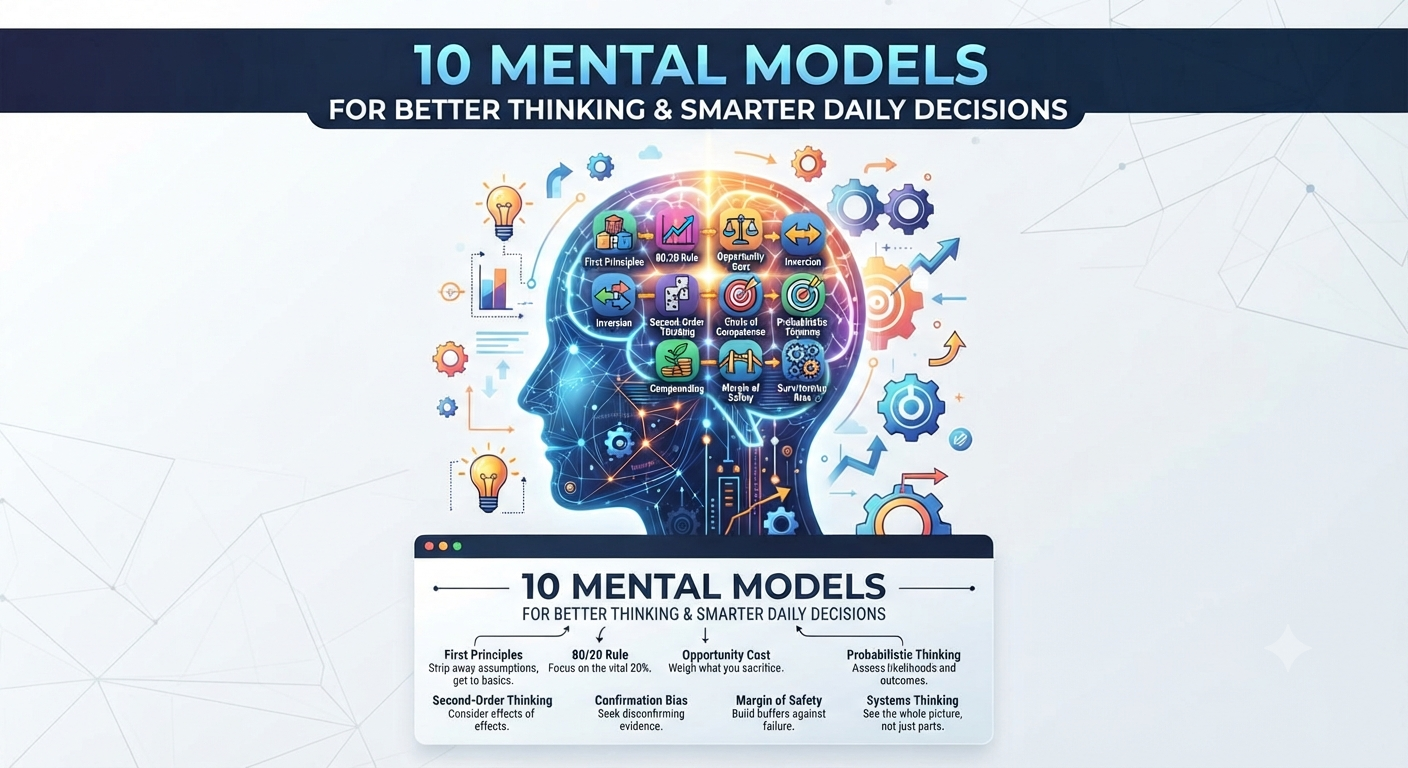
Every day, you make a ton of decisions. Some are tiny, others are massive and life-changing. But what really separates great decision-makers from everyone else isn’t some genius-level IQ or piles of information. It’s how they approach problems.
The world’s best entrepreneurs, scientists, investors you name it lean on mental models. These are simple ways of thinking that help you make sense of tough situations, avoid classic mistakes, and pick smarter options. They’re basically tools. The more you have, and the better you know how to use them, the stronger you get at handling whatever comes your way.
Whether you’re building a business, saving for the future, moving up in your career, or just trying to make better daily choices, these mental models help you think clearer and with more confidence.
Let’s dig into ten of the best mental models you can start using today.
1. First Principles Thinking: Start From Scratch
Most people look around and copy what everyone else is doing. First principles thinking means you stop, forget the “rules,” and break a problem down to its bare basics. Once you get to the core, you build back up from there.
That’s how you get real innovation you’re not trapped by “that’s just how it’s done.”
Try asking yourself:
- What’s absolutely true about this situation?
- What’s just an assumption?
- Could I solve this in a simpler way?
For example, instead of loading your slow website with even more features (just because your competitors do), focus on what people actually want: something fast and easy to use.
2. The 80/20 Rule: Aim for What Matters Most
You’ve probably heard of the 80/20 rule about 80% of your results come from 20% of your efforts.
So instead of trying to do everything, zero in on what drives real results and put your energy there. That might mean focusing on your best clients, selling your most profitable products, or spending more time on skills that really move you forward.
Being productive isn’t about cramming more into your day. It’s about doing more of what actually counts.
3. Opportunity Cost: Every “Yes” Is Also a “No”
You only have so much time, money, and energy. Saying yes to one thing always means you’re saying no to something else.
Before you make a decision, ask yourself: What’s the real cost of choosing this? What am I giving up?
That simple question helps you avoid distractions and put your resources where they’ll actually pay off.
4. Inversion: Flip the Problem Around
Instead of asking, “How do I make this work?” try, “What would definitely make this fail?” Then, make sure you avoid those mistakes.
Looking at things backwards helps you spot risks before they trip you up. For example, want to grow your business? Think about what wrecks businesses: ignoring customers, lousy quality, cash flow problems, being slow to adapt. Focus on dodging those, and you often get closer to winning than by always chasing the next big idea.
5. Second-Order Thinking: Think Past the Obvious
Short-term wins can cause long-term headaches. Second-order thinking asks, “What happens next? And after that?”
Is this quick fix going to become a huge problem down the road? Considering the ripple effects of your choices usually leads to smarter, more solid decisions.
6. Circle of Competence: Know What You’re Good At (and What You’re Not)
Everyone has blind spots. The smartest people know their own limits. They stick to what they’re good at, ask for help when they need it, and always look to learn more.
Knowing what you don’t know can be even more valuable than pretending you’ve got all the answers.
7. Confirmation Bias: Don’t Just Look for Agreement
We naturally seek out stuff that confirms what we already believe. It feels good, but it can really mess up your decisions.
Instead, try listening to people who disagree with you. Ask tough questions. Actually look for reasons you could be wrong. The point isn’t to win an argument it’s to get closer to the truth.
8. The Power of Compounding: Little Wins Add Up
Big success hardly ever happens overnight. Reading a handful of pages each day, working out regularly, learning one new thing a week, or saving a bit every month it doesn’t feel like much right now, but give it time. These efforts compound.
Consistency almost always beats going all-out for a week and then quitting.
9. Margin of Safety: Give Yourself Room to Breathe
Life is unpredictable. Instead of betting everything on best-case scenarios, smart people always leave some wiggle room for things to go wrong.
That means stuff like keeping an emergency fund, giving yourself extra time, steering clear of dumb risks, and having a backup plan. A margin of safety gives you peace of mind and helps you bounce back when life takes a left turn.
10. Systems Thinking: Solve the Real Problem
Nothing really happens in isolation. When something breaks, don’t just patch the surface try to understand the system underneath.
If your business isn’t getting leads, maybe it’s not actually the website’s fault. It could be your messaging, your SEO, your marketing, or something else entirely. Go after the root cause, and you’ll find solutions that actually last.
How to Use These Mental Models Every Day
Reading about this stuff is a start, but using it is what actually changes things.
So next time you’ve got to make a call, stop and ask:
- Am I questioning my assumptions or just following the crowd?
- Am I spending energy on what really moves the needle?
- What am I giving up by making this choice?
- What’s likely to happen next not just right now, but down the road?
- Am I ignoring anything just because it doesn’t fit what I already believe?
- Am I really digging into the root of the problem or just patching a symptom?
You don’t need a ton of time to do this. Just asking these questions can help you dodge some big headaches.
Final Thoughts
Mental models don’t make you smarter just by handing you more facts and figures. They help you use what you know much more effectively.
People who consistently make great decisions usually aren’t the smartest in the room they just see things more clearly.
Start with one mental model. Practice it until it feels natural. Then pick up another.
Over time, you’ll start to notice: you’re making better choices, solving problems faster, sidestepping mistakes, and feeling more confident facing tough calls.
In the end, the quality of your life comes down to the quality of your decisions. And better thinking is where that all begins.
Discussion (0)
Leave a Reply
No confirmed discussions contributed yet. Be the first to start the thread!