Want to feel confident when you speak English no more awkward pauses, no more obsessing over grammar mistakes or constantly translating from your native language? You honestly don’t need to cram thousands of vocabulary words or memorize every grammar rule under the sun.
What matters most is regular practice: speaking out loud, thinking in English, listening closely, and using what you learn. The truth is English speaking is just a skill, and like any skill, it gets better the more you work at it.
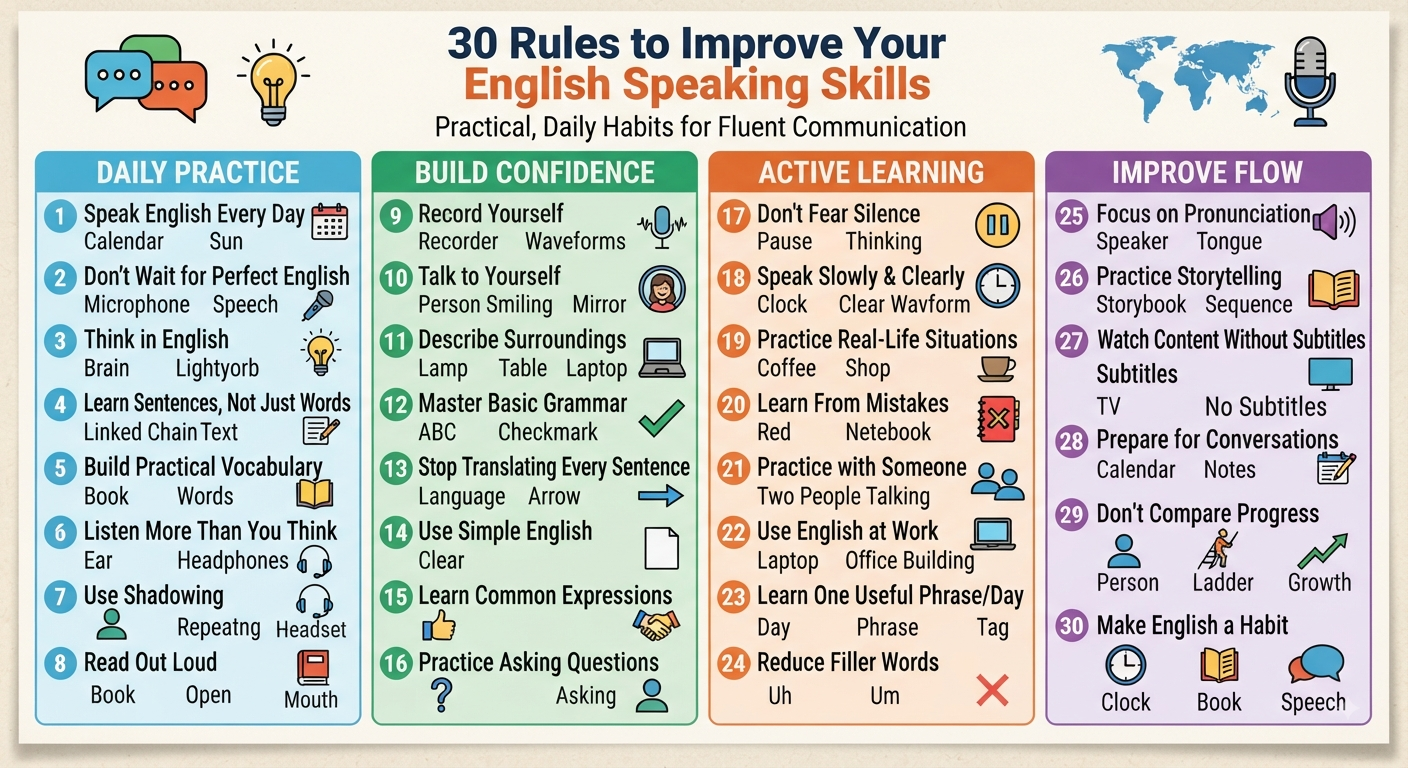
Here are 30 rules that actually help. Try them out, make a habit, and watch your confidence grow.
(Save this article and practice these rules every day. Your future self will appreciate it.)
1. Speak English Every Day
Make it part of your daily life. Fifteen minutes a day beats three hours once a week, hands down. Small daily steps add up.
2. Don’t Wait for Perfect English
A huge mistake is waiting for "perfect English" before you speak. Nobody gets it perfect you’ll make mistakes, but that’s how you learn. Just talk. Mess up. Fix it. Then try again.
3. Start Thinking in English
If you’re always translating from your native language, speaking feels slow and forced. Try to think directly in English even with simple thoughts. Build up to longer sentences as you get comfortable.
4. Learn Sentences, Not Just Words
Memorizing single words doesn’t really help much. Instead, learn phrases or whole sentences: “I haven’t made a decision yet.” You’ll remember and use these way more naturally.
5. Build Practical Vocabulary
Skip random word lists. Focus on vocab you actually use in your life work, family, hobbies, shopping, daily routines. Useful words are ones you use all the time.
6. Listen More Than You Think
Great speakers listen a lot. Dive into podcasts, movies, interviews, YouTube, and real conversations. Notice how words sound and how sentences connect.
7. Use the Shadowing Technique
Try this: Listen to an English sentence, pause, and repeat it just like the speaker. Copy their tune, speed, pauses the whole vibe. It’ll really boost how smoothly you speak.
8. Read Out Loud
Don’t just read quietly. Spend a few minutes reading English aloud every day. It trains your mouth, improves pronunciation, and builds your confidence.
9. Record Yourself Speaking
Pick a topic like “What did I do today?” and talk for a couple minutes. Listen to your recording. You’ll spot repeated words, awkward pauses, pronunciation slips, grammar mistakes, or where you sound unsure. Then you know what to fix.
10. Talk to Yourself in English
You don’t always need a partner. Chat with yourself as you go about your day: “I need to finish this work, then I’ll have lunch, then make a phone call.” It feels odd at first, but it works.
11. Describe Everything Around You
Look around and describe what you see. Start simple, then add details: “There’s a laptop on the table.” Or, “My laptop is hooked up to a monitor, and I’m finishing my work.” This speeds up your thinking in English.
12. Master the Basic Grammar
Don’t stress advanced grammar. Get solid on the basics present, past, and future tense, articles, pronouns, prepositions, questions, and subject-verb agreement. Strong basics carry you far.
13. Stop Translating Every Sentence
Translating slows you down. Instead, learn how English expresses ideas naturally. Think in meaning, not word by word.
14. Use Simple English
You don’t need fancy words to sound smart. “I’m very tired” works fine no need for “I am experiencing considerable exhaustion.” Simple is clear and powerful.
15. Learn Common Expressions
Native speakers repeat certain phrases a lot: “That makes sense,” “Let me think about it,” “I’m not sure,” “It depends,” “As far as I know,” “That’s a good point,” “Could you explain that?” Learn these for smoother conversations.
16. Practice Asking Questions
Don’t just answer ask. Try “What do you think?” “How did you learn that?” “What happened next?” “Why do you think so?” “What would you do?” Good questions keep conversations flowing.
17. Don’t Fear Silence
You don’t have to respond instantly. Pause, breathe. Instead of stumbling through “Umm… umm… actually…” say “Let me think for a moment.” Pauses sound natural.
18. Speak Slowly and Clearly
Rushing doesn’t mean fluency. First focus on clarity and accuracy speed comes with confidence.
19. Practice Real-Life Situations
Don’t just make up sentences; practice ones you’ll really use at restaurants, at work, in meetings. Like, “I’d like to order a coffee and a sandwich,” or “Could you send me the report by tomorrow?” The more real the practice, the more useful.
20. Learn From Your Mistakes
Keep a notebook for your errors. Write down mistakes and corrections, like “He don’t like coffee” → “He doesn’t like coffee.” Review them often your mistakes are your best teachers.
21. Practice With Someone
Find a friend, colleague, teacher, or language partner. Set a rule: only speak English for 15–30 minutes. Skip grammar lectures just talk.
22. Use English at Work
If you can, weave more English into your job write emails, join meetings, give short presentations, explain tasks in English. This builds confidence where it counts.
23. Learn One Useful Phrase a Day
Don’t go crazy with memorizing. Pick ONE phrase like “I’ll get back to you”and use it everywhere that day until it feels natural.
24. Reduce Filler Words
Notice how you use “umm,” “like,” “actually,” “you know,” “basically” when you’re nervous. Don’t try to erase them totally just pause instead.
25. Improve Your Pronunciation
The goal is to be understood, not to sound “perfect.” Pick tricky words, listen to how they’re pronounced, repeat them, then use them in sentences.
26. Practice Storytelling
Tell a story what happened today, anything. Structure it: beginning, then what happened, then what next, then the end. Like, “Yesterday, I went to a café with a friend. We ordered coffee, but something unexpected happened…” Storytelling makes you use vocab, grammar, linking words, and different tenses all at once.
27. Watch English Content Without Subtitles Sometimes
Start with subtitles if you need them. But eventually, challenge yourself to watch short clips without them. Don’t fuss over every word. Aim to grasp the big picture.
28. Practice Before Important Conversations
Got an interview? Presentation? Meeting? Prepare in advance. Practice aloud. Prep questions and answers. It calms nerves and helps you perform better.
29. Don’t Compare Your English With Others
Someone else’s fluency probably comes from years of practice. Compare yourself to yesterday, not to someone else's decade of work. Your progress matters most.
30. Make English a Habit
This is the big one. Don’t treat English like a school subject for exams or interviews. Make it part of your daily routine: listen, speak, read, write then repeat. Even half an hour a day delivers real results over time.
A Simple 30-Minute Daily English Routine
Try this every day:
- 5 minutes — Learn 3–5 useful words or phrases.
- 5 minutes — Listen to a short English conversation.
- 5 minutes — Shadow and repeat what you hear.
- 10 minutes — Speak about your day, work, plans, or any topic you like.
- 5 minutes — Record yourself and find one thing to improve tomorrow.
That's your 30 minutes. The point isn’t perfection it’s consistency.
The 30-Day Challenge
For the next month:
- Days 1–10: Focus on simple sentences.
- Days 11–20: Speak for longer stretches.
- Days 21–30: Practice conversations and storytelling.
Don’t stress about perfection. Just aim to get a little more comfortable and confident every day.
Final Thought
You don’t become a good English speaker just by knowing the language you become one by using it. So stop waiting for perfect vocab, perfect grammar, or the right moment. Stop worrying about mistakes or what others think.
Just start speaking.
Start now.
Just one sentence today. Then one conversation tomorrow. That’s how you build confidence.
Save this article, revisit these rules, and make practice your habit.
Your English grows the moment you do.
Discussion (0)
Leave a Reply
No confirmed discussions contributed yet. Be the first to start the thread!