Let’s be honest when you hear a company pulled in ₹100 crore in revenue, it’s easy to think, “Wow, they must be crushing it.” But that’s just one part of the story. A business can post huge sales numbers and still walk away with barely any profit or worse, a loss.
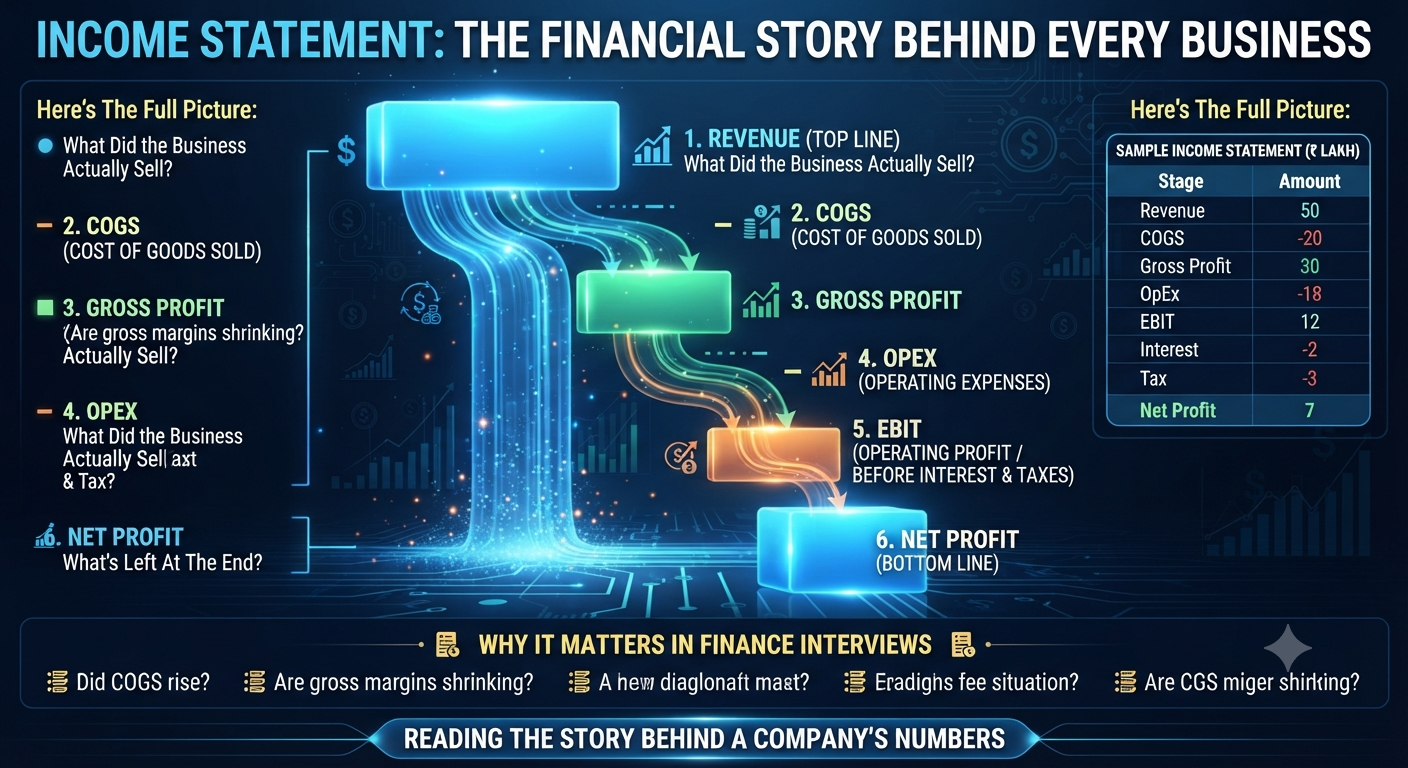
To see what’s really happening inside, finance folks always look at the Income Statement. Think of this as following a trail from the top of the mountain down to the very bottom:
Revenue → COGS → Gross Profit → OpEx → EBIT → Net Profit
Every step down tells you something new.
1. Revenue: What Did the Business Actually Sell?
Revenue is the cash a company pulls in from its main work. If a company sells ₹50 lakh worth of goods in a year, its revenue is ₹50 lakh. You’ll hear people call this the top line, because no surprise it sits right at the top of the Income Statement.
But here’s the catch: high revenue doesn’t guarantee high profit. Costs can eat into earnings pretty quickly if you aren’t careful.
2. COGS: What Did It Cost to Produce the Goods?
COGS (Cost of Goods Sold) means the direct costs of making and selling the stuff. For a clothing maker, that’s things like fabric, labor, and factory costs tied straight to those shirts or jeans.
Take a quick example:
- Revenue = ₹50 lakh
- COGS = ₹20 lakh
So, after paying for the basics, the company has ₹30 lakh left. That’s its Gross Profit.
3. Gross Profit: Is the Core Business Actually Profitable?
Gross Profit = Revenue − COGS
Using the numbers above: ₹50 lakh − ₹20 lakh = ₹30 lakh.
This shows you how much the company keeps after covering just the direct costs. And if you want a clearer picture, check the Gross Profit Margin that tells you how much of your sales is actually sticking around as profit before you pay the bills to keep the lights on.
4. OpEx: What Does It Cost to Run Everything Else?
Now, let’s say the company spends ₹18 lakh on all the other stuff salaries, marketing, rent, software, admin, whatever it takes to keep the business running. Add that all up, and you get Operating Expenses (OpEx).
So after paying those expenses out of the ₹30 lakh gross profit, the company’s left with ₹12 lakh before paying for interest and taxes.
5. EBIT: How Much Profit, Before Loans and Taxes Eat Into It?
EBIT stands for Earnings Before Interest and Taxes think of it as the profit the core business is truly generating, before the bank or the taxman gets their share.
Here’s the breakdown:
- Gross Profit: ₹30 lakh
- Minus OpEx: ₹18 lakh
- EBIT: ₹12 lakh
Why do analysts care about EBIT? It shows how well the business is ticking, with no distortion from financing or tax stuff.
6. Net Profit: What’s Left At The End?
Now, let’s subtract interest (₹2 lakh) and taxes (₹3 lakh):
- ₹12 lakh (EBIT)
- – ₹2 lakh (Interest)
- – ₹3 lakh (Tax)
- = ₹7 lakh Net Profit
This, right here, is the “bottom line.” The company started with ₹50 lakh in sales and, after all costs, kept ₹7 lakh.
Here’s The Full Picture
| Stage | Amount |
|---|---|
| Revenue | ₹50 lakh |
| COGS | ₹20 lakh |
| Gross Profit | ₹30 lakh |
| OpEx |
₹18 lakh |
| EBIT | ₹12 lakh |
| Interest | ₹2 lakh |
| Tax | ₹3 lakh |
| Net Profit | ₹7 lakh |
So, in this simple example, the company brings in ₹50 lakh in revenue but only keeps ₹7 lakh in profit when it’s all said and done.
Why Do Finance Interviewers Ask About the Income Statement?
They’re trying to see if you get how a business really makes money not just the accounting words, but the story behind the numbers. If someone says, “Revenue went up, but profit dropped. Why?” you should immediately think:
- Did COGS rise?
- Are gross margins shrinking?
- Are salaries or marketing expenses climbing?
- Did operating costs go up?
- Are we paying more in interest or tax?
- Anything else eating into the numbers?
That’s the mindset finance roles are built on.
The 6 Numbers To Remember
If you’re gearing up for a finance interview, keep this road map handy:
- Revenue: What did we sell?
- COGS: What did it really cost us to make it?
- Gross Profit: What’s left after direct costs?
- OpEx: What does it cost just to keep the business running?
- EBIT: How much are we making, before interest and tax bite?
- Net Profit: What do we really keep at the end?
Once these steps make sense, you’re not blindly memorizing terms anymore you’re actually reading the story behind a company’s numbers.
Keep this guide for your finance interview prep, and pass it along to anyone learning accounting or finance. It’s the real backbone behind the business headlines.
Discussion (0)
Leave a Reply
No confirmed discussions contributed yet. Be the first to start the thread!